Donation & Charity(Food donati...
September 1, 2026
9 min read
Last updated: September 1, 2026
The 9 Forms of Durga: A Complete Navdurga Guide for Navratri 2026
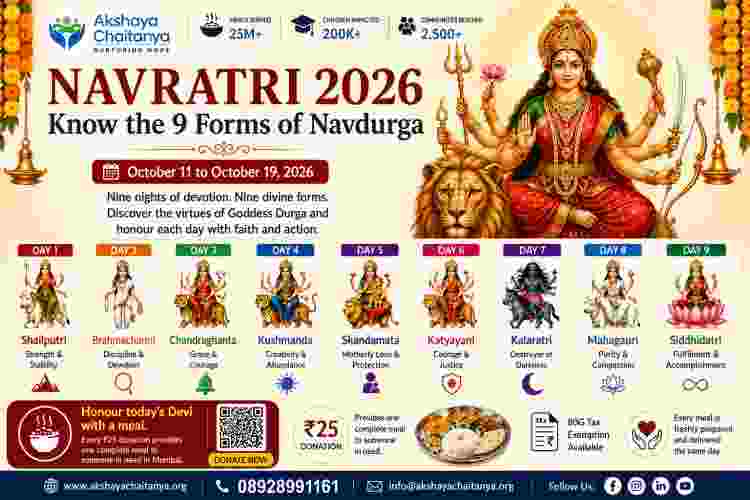
Navratri's nine nights aren't nine repetitions of the same worship; they're a journey through nine distinct forms of Goddess Durga, collectively known as the Navdurga, each representing a different quality, stage, or aspect of the divine feminine. Understanding who is being honoured each day, from October 11 through October 19, 2026, adds a depth to the festival that goes well beyond puja timing and colour coordination.
What Is Navdurga? Understanding the Nine Forms
The concept of Navdurga comes from classical Devi worship traditions, particularly the Devi Mahatmya, and represents Durga not as a single, static figure, but as a goddess who manifests in nine distinct forms across the nine nights of Navratri, each embodying a specific virtue or life stage. Together, these nine forms trace an arc from foundational strength through discipline, grace, abundance, protection, and ultimately, spiritual accomplishment.
This structure reflects a broader idea common across Hindu philosophy: that the divine feminine encompasses the full range of qualities needed across a life, from raw resilience to refined wisdom, rather than being defined by any single trait.
Day 1: Shailputri
Shailputri, meaning daughter of the mountains, represents Durga in her most foundational form, embodying strength, stability, and groundedness. She is often depicted riding a bull, holding a trident and lotus, symbolising the raw, unshakeable power from which all other forms of the goddess emerge. Worship on this first day is considered to set the tone and intention for the entire nine-day period.
Day 2: Brahmacharini
Brahmacharini represents the unmarried, ascetic form of the goddess, embodying discipline, penance, and single-minded devotion. She is depicted holding a rosary and water pot, reflecting a life dedicated to spiritual pursuit and self-control. This form is often invoked by those seeking clarity, focus, and perseverance in their own goals.
Day 3: Chandraghanta
Chandraghanta, whose name references the crescent moon (chandra) she wears on her forehead shaped like a bell (ghanta), represents grace paired with fierce readiness to combat evil. She is depicted with ten arms, each bearing weapons, riding a tiger, embodying the idea that peace and grace can coexist with strength and preparedness.
Day 4: Kushmanda
Kushmanda is believed to have created the universe with her divine smile, and her name is associated with the cosmic egg from which creation emerged. She represents abundance, creative energy, and the life-giving force believed to sustain the sun itself. Worship on this day often centres on gratitude for abundance and the energy that sustains life.
Day 5: Skandamata
Skandamata, literally mother of Skanda (the deity Kartikeya), represents motherhood in its most powerful form: fierce, protective love. She is depicted holding her infant son, embodying the idea that a mother's care is itself a form of divine strength. This day is often associated with prayers for the wellbeing of children and family.
Day 6: Katyayani
Katyayani represents Durga in warrior form, born specifically to destroy the demon Mahishasura, and is closely associated with courage, righteous anger, and the willingness to fight injustice. This form is particularly significant in the lead-up to Ashtami and Navami, foreshadowing the goddess's ultimate victory that Navratri as a whole commemorates.
Day 7: Kalaratri
Kalaratri, meaning the night of death or the dark night, is Durga's fiercest form, depicted with dark skin, dishevelled hair, and a fearsome countenance, yet paradoxically considered a bestower of good fortune upon her devotees. She represents the destruction of ignorance and darkness, and the courage required to face what is genuinely frightening.
Day 8: Mahagauri (Durga Ashtami)
Mahagauri, meaning extremely fair or radiant, represents purity, serenity, and compassion, believed to have earned her radiant form through intense penance. Worship on Durga Ashtami, falling on October 18, 2026, is considered especially powerful, and is the day most closely associated with Kanya Pujan, worshipping young girls as living embodiments of the goddess's pure, compassionate nature.
Day 9: Siddhidatri (Maha Navami)
Siddhidatri, meaning bestower of supernatural powers and accomplishment, represents the culmination of the entire nine-day journey: spiritual attainment, fulfilment, and mastery. Worshipped on Maha Navami, October 19, 2026, she is often depicted seated on a lotus, having granted her devotees the various siddhis (accomplishments) sought throughout the preceding eight days of worship and devotion.
Which Form of Durga Are You Drawn to This Year
Reading through these nine forms, many people find themselves drawn to one or two in particular, perhaps Skandamata's fierce maternal love, or Kalaratri's unflinching courage, or Mahagauri's serene compassion, depending on what's present in their own life this year. There's no requirement to feel equally connected to all nine; the tradition itself acknowledges that different qualities matter more at different times, which is part of why the festival is structured as a journey through distinct forms rather than repeated worship of a single, undifferentiated goddess.
This is also part of why the Navdurga tradition has remained so enduringly relatable across generations. A festival built around nine distinct emotional and spiritual registers gives every devotee, regardless of what they're personally navigating that year, a form of the goddess to genuinely connect with. Someone facing a difficult decision might find themselves gravitating toward Brahmacharini's discipline; someone healing from a loss might feel closest to Kalaratri's fearless confrontation with darkness. The nine forms function almost like a spiritual toolkit, offering a different register of strength for whatever a devotee happens to be carrying that particular year.
Honour Her Virtue With an Act of Giving
Each of these nine forms offers a natural, specific way to translate devotion into action, beyond puja alone. Consider Kushmanda's association with abundance and life-sustaining energy: what better way to honour her than ensuring someone else has enough to sustain themselves today? Or Skandamata's fierce maternal protection: what more direct expression than making sure a child somewhere has a meal?
Akshaya Chaitanya's Navratri donation programme offers exactly this opportunity, letting you tie your giving to whichever day's virtue resonates most with you this year. Every ₹25 donated funds one complete meal for someone in need across Mumbai, prepared fresh and delivered the same day, with an 80G tax exemption receipt for your contribution. Whether you're moved by Kushmanda's abundance, Skandamata's protection, or Siddhidatri's accomplishment, there's a meaningful way to carry that day's specific energy into a real act of care. If you'd like to extend your giving beyond Navratri itself, our general food donation programme and main donation page remain open throughout the year.
Honour today's Devi with a meal: https://akshayachaitanya.org/donate/charity-on-navratri
Frequently Asked Questions
What are the nine forms of Durga called collectively? They are collectively known as the Navdurga, worshipped across the nine nights of Navratri, from Shailputri on Day 1 to Siddhidatri on Day 9.
Which Navdurga form is worshipped on Durga Ashtami? Mahagauri, representing purity and compassion, is worshipped on Durga Ashtami, falling on October 18, 2026, and is closely associated with Kanya Pujan.
Do I need to worship all nine forms individually to observe Navratri properly? No. Many families focus on the days most meaningful to them, particularly Ghatasthapana, Ashtami, and Navami, while still honouring the broader spirit of the nine-day journey.
Which form is associated with Maha Navami? Siddhidatri, representing spiritual accomplishment and fulfilment, is worshipped on Maha Navami, falling on October 19, 2026, marking the culmination of the nine-day festival.
This Navratri, honour whichever Devi's virtue speaks to you most: donate a meal in her spirit and turn devotion into care for someone in need.
Frequently Asked Questions
Take Action
Be the reason someone
eats tonight.
Join 12,000+ donors funding hot, freshly cooked meals across India. 100% transparent. Tax-exempt under 80G.
What our customers say


630+ reviews
as on 02/09/2026

Manogya Gondela
a month ago
I had the opportunity to donate and serve food at one of the hospitals that Akshaya Chaitanya serves. It was a wonderful experience and truly inspiring to be part of such a meaningful initiative. The food quality was excellent and well prepared. 10/10 experience ♥️

Abhijit Goldar
a month ago
Really grateful to have found them. They helped arrange a food donation event on very short notice. Everything was well coordinated, professionally managed, and photos were shared promptly after the event. Great work!

Avani Patel
4 months ago
It is wonderful to have an NGO like this for people who cannot always volunteer physically. The donation process is simple and convenient, and I appreciate receiving updates and photos showing the impact of every contribution.

namrata avaghade
5 months ago
It has been an amazing experience with Akshaya Chaitanya. The volunteers are very helpful, and the guidance from the team made everything easy and inspiring. Proud to be associated with an organization that serves with heart and purpose.

riddhi sonkar
6 months ago
I have been volunteering at this food donation camp for patients’ relatives and I am truly proud of the work we do. The meals are fresh, hygiene is maintained, and distribution is well organized. A wonderful initiative supporting families during difficult times.

Kishor Waghmare
a year ago
My family joined a food donation drive at Chhatrapati Shivaji Maharaj Hospital, Kalwa. It was a wonderful experience. The volunteers were supportive, the arrangements were excellent, and serving those in need brought joy to all of us. I encourage everyone to support this noble cause.
✅ FCRA Registered · 80G Tax Exempt · FSSAI Certified