Donation & Charity
September 1, 2026
9 min read
Last updated: September 1, 2026
Ganpati Sthapana 2026: A Complete Step-by-Step Guide
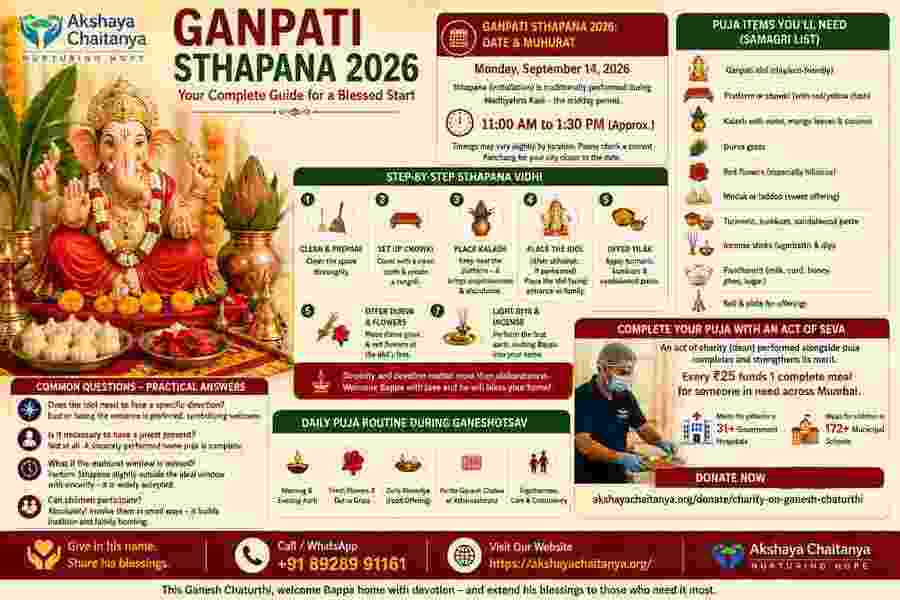
Bringing Ganpati home is, for many families, the most anticipated moment of the entire festival — the point where anticipation turns into presence. Getting the Sthapana right matters, not because a small mistake will undo the occasion's spirit, but because a clear, calm process lets you focus on the moment itself rather than scrambling for missing items or uncertain timing. Here's everything you need for a smooth Ganpati Sthapana in 2026.
Ganpati Sthapana 2026: Date & Muhurat
Ganesh Chaturthi 2026 falls on Monday, September 14, and Sthapana (installation) is traditionally performed during the Madhyahna Kaal — the midday period, generally considered the most auspicious window for welcoming Ganpati into the home, since this is believed to be the time of day he was born.
For 2026, the recommended Madhyahna muhurat falls approximately between 11:00 AM and 1:30 PM, though this can shift slightly by location and specific Panchang. It's worth checking a current Panchang for your city closer to the date, since even a difference of a few minutes in sunrise time can shift the precise window.
Some families, particularly those unable to perform Sthapana during the exact Madhyahna window due to work or travel, install Ganpati in the morning or early evening instead — a widely accepted practice, particularly given how differently modern schedules operate compared to when these muhurat windows were first established.
Puja Items You'll Need (Samagri List)
Having everything ready before the muhurat window begins makes the whole process considerably smoother. A typical Ganpati Sthapana samagri list includes:
- The Ganpati idol — clay (shadu maati) or another eco-friendly material is strongly recommended over Plaster of Paris, given the environmental impact of immersion
- A clean platform or chowki, ideally covered with a red or yellow cloth
- Red cloth (vastra) for draping around or near the idol
- Kalash (a small vessel, typically copper or brass) filled with water, topped with mango leaves and a coconut
- Durva grass — considered one of Ganesha's most beloved offerings, and rarely skipped
- Red flowers, particularly hibiscus, along with a general flower assortment
- Modak or laddoo as the primary sweet offering
- Turmeric, kumkum, and sandalwood paste for tilak
- Incense sticks (agarbatti) and a diya for aarti
- Panchamrit (a mixture of milk, curd, honey, ghee, and sugar) for abhishek, if performed
- A bell for aarti, and a small plate for offerings
None of these items need to be elaborate or expensive — what matters, as with most Hindu ritual practice, is sincerity and consistency rather than scale. Many families build their samagri collection gradually over the years, reusing items like the kalash and bell each season while replenishing only the perishables — flowers, durva grass, and sweets — fresh each time.
Step-by-Step Sthapana Vidhi
- Clean and prepare the space. The area where Ganpati will be installed should be thoroughly cleaned the day before or the morning of Sthapana.
- Set up the chowki. Cover it with a clean cloth, and if you like, create a small rangoli beneath or around it.
- Place the kalash near the platform, filled with water, topped with mango leaves and a coconut — this represents auspiciousness and abundance.
- Bathe the idol gently (if performing abhishek) with water or panchamrit, then pat dry and place it on the platform facing the entrance or the family, depending on tradition.
- Offer tilak with turmeric, kumkum, and sandalwood paste on the idol's forehead.
- Offer durva grass and red flowers, placing them at the idol's feet.
- Light the diya and incense, and perform the first aarti of the festival, inviting Ganpati's presence formally into the home.
- Offer modak or your prepared sweet, along with a short prayer welcoming him for the days ahead.
This sequence can be adapted based on family tradition, the guidance of a priest if one is present, or simply what feels most natural to your household — there is no single "correct" version beyond the broad structure of cleansing, welcoming, and offering.
Common Questions First-Timers Have About Sthapana
For anyone performing Ganpati Sthapana for the first time — perhaps having moved into their own home for the first time, or taking on the responsibility from parents or grandparents — a few practical questions tend to come up that formal ritual guides don't always address. Does the idol need to face a specific direction? Generally, east or facing the entrance is preferred, symbolising welcome, though many households simply place it wherever it can be seen and cared for comfortably by the whole family. Is it necessary to have a priest present? Not at all — while a priest's guidance adds a layer of ritual precision some families value, a sincerely performed home version, following the broad steps above, is considered entirely complete. What if the muhurat window is missed due to work or travel? Performing Sthapana slightly outside the ideal window, with sincerity, is far more widely practised — and accepted — than the strict letter of Panchang timing might suggest.
Daily Puja Routine During Ganeshotsav
Once Sthapana is complete, most families perform a simplified version of this routine daily until Visarjan — typically a morning and evening aarti, fresh flowers, and a food offering (naivedya) each day, often rotating between different sweets and dishes through the festival's duration. Some families also read or recite the Ganesh Chalisa or Atharvashirsha as part of the daily routine.
The specific rituals matter less than the consistency: Ganpati is, in the spirit of this festival, being treated as a present member of the household for these ten days (or however many your family observes), and the daily routine reflects that ongoing care and attention rather than a one-time event. Many families also use this daily window as a moment of togetherness — children participating in small ways, like offering flowers or ringing the bell during aarti, and the routine becoming as much about family rhythm as it is about ritual precision.
Complete Your Puja With an Act of Seva
There's a detail easy to overlook amid the preparation of samagri lists and muhurat timings: across nearly every Hindu ritual tradition, an act of charity — daan — performed alongside or immediately after a puja is considered to complete and strengthen its merit. This is true for Ganpati Sthapana as much as any other ritual occasion.
If your Sthapana preparations are complete and you're looking for a meaningful way to round out the occasion, donating toward Akshaya Chaitanya's Ganesh Chaturthi meal programme is a direct, tangible way to do exactly that. Every ₹25 funds one complete meal, prepared fresh and served the same day to patients across Mumbai's government hospitals or children in municipal schools — an offering made in Ganpati's name, alongside the puja you've just performed at home.
If you'd rather support this cause on an ongoing basis, beyond just the festival period, Akshaya Chaitanya's general food donation programme welcomes contributions any day of the year, and the main donation page lets you explore the full range of causes we support — from ongoing meal programmes to occasion-specific giving throughout the year.
Complete your Ganpati puja with an act of seva →
Frequently Asked Questions
What is the best time for Ganpati Sthapana 2026? The Madhyahna Kaal (midday) muhurat, approximately 11:00 AM to 1:30 PM on September 14, 2026, is traditionally considered most auspicious, though timing can be adjusted for practical family schedules.
Is a clay idol necessary, or can I use any material? Clay (shadu maati) or other eco-friendly materials are strongly recommended over Plaster of Paris idols, primarily due to the environmental impact of immersing non-biodegradable materials in water bodies during Visarjan.
What if I can't perform the full Sthapana ritual with a priest? A simplified home version — cleaning the space, offering flowers, durva grass, and a sweet, followed by aarti — is a widely accepted and complete way to welcome Ganpati, especially for families without easy access to priestly guidance.
Do I need to perform puja every single day during Ganeshotsav? A daily routine of aarti and offerings is traditional, but the specific frequency and elaborateness can be adapted to your family's schedule — consistency and sincerity matter more than ritual completeness every single day.
Complete this year's Ganpati Sthapana with an act that reaches beyond your home — donate a meal in his name today.
Frequently Asked Questions
Take Action
Be the reason someone
eats tonight.
Join 12,000+ donors funding hot, freshly cooked meals across India. 100% transparent. Tax-exempt under 80G.
What our customers say


630+ reviews
as on 02/09/2026

Manogya Gondela
a month ago
I had the opportunity to donate and serve food at one of the hospitals that Akshaya Chaitanya serves. It was a wonderful experience and truly inspiring to be part of such a meaningful initiative. The food quality was excellent and well prepared. 10/10 experience ♥️

Abhijit Goldar
a month ago
Really grateful to have found them. They helped arrange a food donation event on very short notice. Everything was well coordinated, professionally managed, and photos were shared promptly after the event. Great work!

Avani Patel
4 months ago
It is wonderful to have an NGO like this for people who cannot always volunteer physically. The donation process is simple and convenient, and I appreciate receiving updates and photos showing the impact of every contribution.

namrata avaghade
5 months ago
It has been an amazing experience with Akshaya Chaitanya. The volunteers are very helpful, and the guidance from the team made everything easy and inspiring. Proud to be associated with an organization that serves with heart and purpose.

riddhi sonkar
6 months ago
I have been volunteering at this food donation camp for patients’ relatives and I am truly proud of the work we do. The meals are fresh, hygiene is maintained, and distribution is well organized. A wonderful initiative supporting families during difficult times.

Kishor Waghmare
a year ago
My family joined a food donation drive at Chhatrapati Shivaji Maharaj Hospital, Kalwa. It was a wonderful experience. The volunteers were supportive, the arrangements were excellent, and serving those in need brought joy to all of us. I encourage everyone to support this noble cause.
✅ FCRA Registered · 80G Tax Exempt · FSSAI Certified